
Oslo Research Centre for Physical Activity and Population Health
ORC-PAPH aims to strengthen population health through research on physical activity, sedentary time and physical fitness, and by translating research-based knowledge into policy, clinical practice and population-level interventions.

About the Centre
The Oslo Research Centre for Physical Activity and Population Health (ORC-PAPH) is a research centre at the Department of Sports Medicine at the Norwegian School of Sport Sciences. Through a long-term research programme, the Centre aims to be a leading national and international hub for research on physical activity, sedentary time, physical fitness and health.
The Centre builds on several decades of internationally recognised research. Through national surveillance studies, register linkages, methodological development, intervention and implementation studies, and close collaboration with health authorities and international research environments, ORC-PAPH will contribute to new knowledge, better population health and evidence-based policy and practice.
The active involvement of students and early-career researchers is an integral part of the Centre’s activities and will contribute to long-term competence development and continuity across generations of researchers.
Contact
- Email: orcpaph@nih.no
Our objectives
The objectives of the Centre are:
Physical activity, sedentary time and physical fitness in the population
ORC-PAPH will generate new knowledge about how physical activity, sedentary time and physical fitness vary between different groups in the Norwegian population. Among other things, we investigate differences by age, sex and socioeconomic circumstances, the types of activity in which people participate, and how activity patterns develop over time.
Since 2005, the research community at NIH has conducted national surveillance studies among children, adolescents, adults and older adults in collaboration with the health authorities. These repeated, population-based measurements provide Norway with a unique evidence base for monitoring trends in physical activity and physical fitness and for developing evidence-based policy and public health interventions.
The Centre will further develop these surveillance studies through more representative samples, better inclusion of groups that are often underrepresented in population studies, long-term data storage and linkages to register data. We will also develop new methods, including the use of artificial intelligence, to measure and analyse physical activity and sedentary time more precisely.
Dose–response relationships between activity and health
ORC-PAPH will generate new knowledge about how the amount, intensity and pattern of physical activity and sedentary time affect health, disease risk and longevity. A key objective is to investigate the health benefits that may be achieved through small changes in everyday activity, reduced sedentary time, and taking more or faster steps.
By combining precise measurements from activity monitors with large population studies, register data and advanced analytical methods, we will strengthen knowledge about causal relationships. Among other things, we will investigate how physical activity and sedentary time affect the risk of cardiovascular disease, cancer, type 2 diabetes, dementia, mental health problems and premature death.
The Centre will also investigate how these relationships vary between different population groups and among people already living with chronic diseases. The aim is to develop a more precise evidence base for guidelines and interventions tailored to different groups within the population.
Intervention and implementation studies
ORC-PAPH will conduct intervention and implementation studies to investigate how physical activity and exercise can be used in prevention and treatment, and how evidence-based services can be integrated into primary and specialist healthcare.
The research includes both studies of how physical activity affects health, physical function and quality of life, and studies of how effective interventions can be organised, delivered and scaled up within routine patient pathways. Relevant research areas include cardiovascular health, pulmonary health, mental health, pain and physical function.
The work builds, among other things, on experience from Exercise is Medicine Norway. The Centre will develop and evaluate models in which physical activity forms an integral part of prevention, treatment and follow-up, including in collaboration with GP practices, Healthy Life Centres and other parts of the health service.
NIH educates Health and Exercise Physiologists with specialised expertise in the use of physical activity in prevention and treatment. ORC-PAPH will contribute research and an evidence base that can strengthen the use of this expertise in health and care services.
From research to policy and practice
ORC-PAPH will help ensure that research-based knowledge about physical activity, sedentary time and physical fitness is applied in national and international guidelines, public health policy, clinical practice and population-level interventions.
Translating research into action is a core task of the Centre. Through collaboration with the Norwegian Institute of Public Health, the Norwegian Directorate of Health, the World Health Organization (WHO), and other national and international organisations, ORC-PAPH will be a prominent source of evidence and advice for evidence-based public health work.
The Centre will contribute to the development and revision of Norwegian, Nordic and international guidelines on physical activity and sedentary time. We will also provide data and knowledge for national and international indicator and surveillance systems.
Through factsheets, evidence summaries, seminars, webinars, dialogue meetings and research communication, we will make research accessible to public authorities, healthcare professionals, decision-makers and the general public. We will also develop practice-oriented resources that can support the health service in using physical activity in prevention, treatment and follow-up.
Centre management


Other staff
(Alphabetical order)
As of June 2026: Due to an error in NIHs systems, several staff pages have temporarily been unpublished. If you need to contact one of the staff and their page is not available, please send an email to orcpaph@nih.no.
- Adriano Sánchez Lastra (external)
- Anders Husøy
- Bjørge Hansen
- Elisabeth Teinung
- Elin Kolle
- Hege Clemm
- Jacob Tarp
- Jostein Steene-Johannessen
- Julie Stang
- Knut Eirik Dalene (external: The Norwegian Institute of Public Health (NIPH))
- Lars Emil Sætrang
- Mari Bratteteig
- Melina M. Magulas
- Morten Wang Fagerland
- Oddbjørn Klomsten Andersen
- Tom-Daniel Laugerud
- Trine Stensrud
Partners
World Health Organization
ORC-PAPH is designated as the WHO collaborating centre on Physical Activity and Population Health.
Norwegian Institute of Public Health
ORC-PAPH signed a collaboration agreement with Norwegian Institute of Public Health (NIPH) in December 2025.
News from the Centre
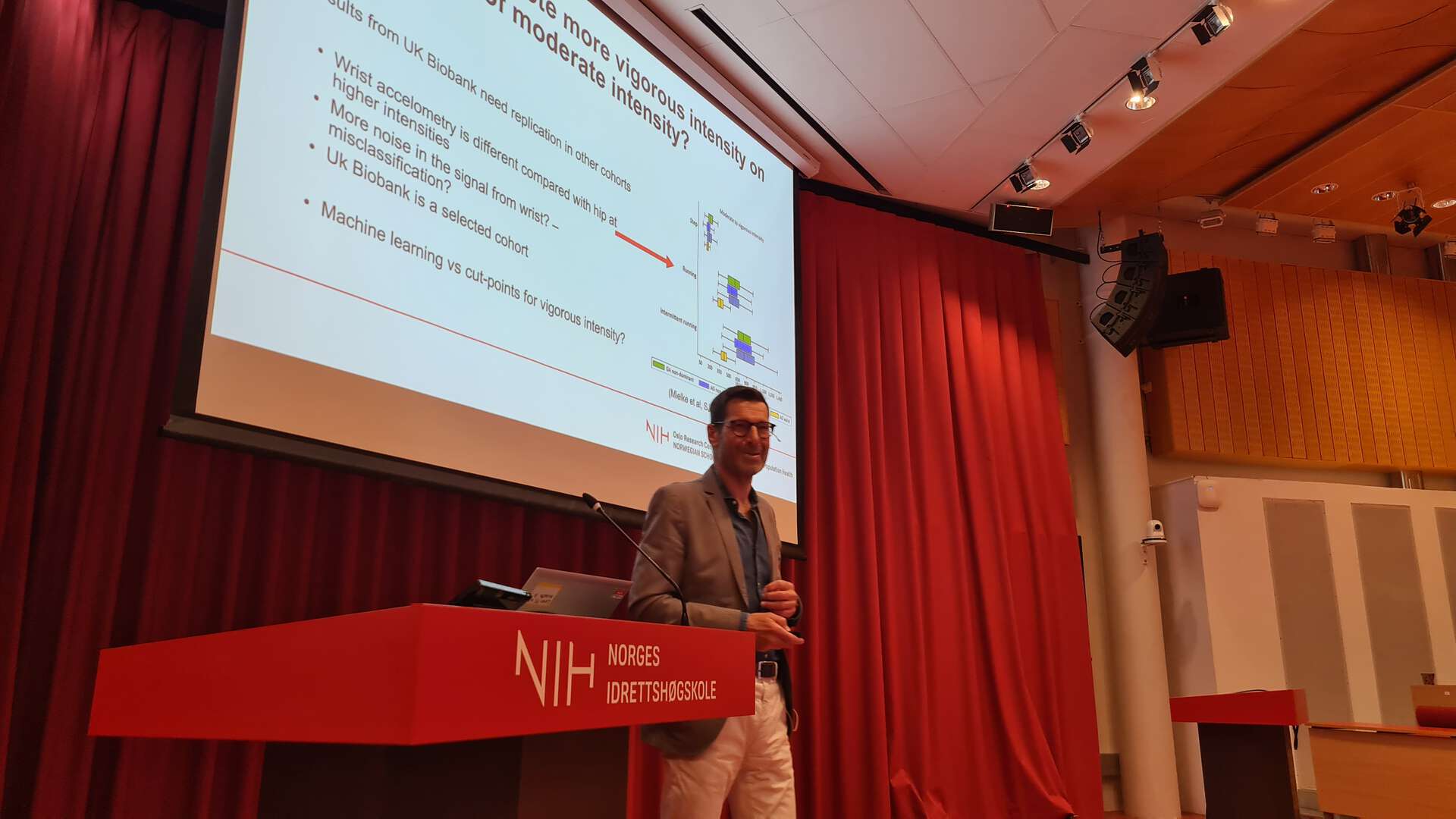
Recordings from the opening of ORC-PAPH
Here you will find recordings from the opening of the Oslo Research Centre for Physical Activity and Population Health (ORC-PAPH) and the celebration of 20 years of national physical activity monitoring, held at the Norwegian School of Sport Sciences on 16–17 April 2026.

Small increases in physical activity may reduce mortality
A brisk extra five-minute walk per day could potentially prevent many deaths. The study, conducted by researchers at the Norwegian School of Sport Sciences in collaboration with Uppsala University and others, has been published in The Lancet.