
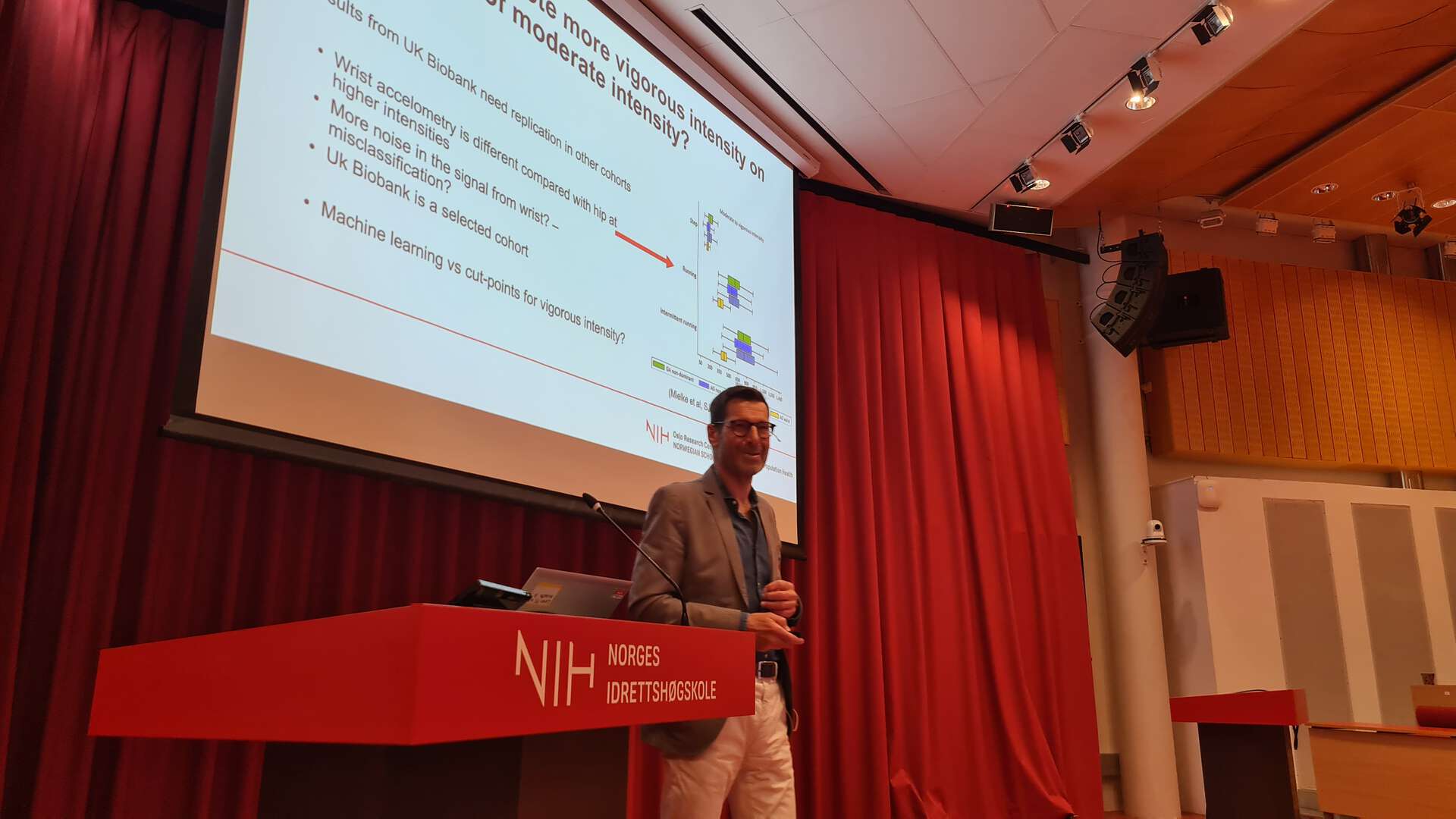
The event marked the establishment of ORC-PAPH as a research centre, its role as a WHO Collaborating Centre, and the 20th anniversary of Norway’s national studies of physical activity and physical fitness, KAN and ungKAN. The lectures present knowledge on physical activity, physical fitness, public health, measurement methods, population surveillance, non-communicable diseases, and how research can be applied in policy and practice.
The event received funding from the Research Council of Norway, and an important aim of making the recordings available is to support knowledge sharing among researchers, students, decision-makers, practitioners and others with an interest in physical activity and public health.
Some presentations may include preliminary findings, unpublished data or ongoing research. The content reflects the speakers’ professional assessments and the knowledge available at the time of recording. The subtitles have been generated automatically and may contain errors.
Part one was presented in Norwegian, so the recordings can be viewed on the Norwegian version of this page.
PART 2 – Opening of ORC-PAPH and International Perspectives
This session marks the formal opening of ORC-PAPH as a WHO Collaborating Centre, and as a partner with the Norwegian Institute of Public Health (FHI). It highlights physical activity in a global context and features speakers with insights into global recommendations, research, and trends.
See recordings from part 2
Introduction and opening of ORC-PAPH
The formal opening of the Oslo Research Centre for Physical Activity and Population Health (ORC-PAPH). The remarks present the centre’s aims, societal role and the importance of the strengthened collaboration between the Norwegian School of Sport Sciences, the Norwegian Institute of Public Health and WHO.
Speaker(s): Aage Radmann, Guri Rørtveit, Sigmund Anderssen
ORC-PAPH as a WHO Collaborating Centre
Juana Willumsen and Ulf Ekelund explain what a WHO Collaborating Centre is and how ORC-PAPH will contribute to WHO’s work. The presentation outlines the centre’s role in physical activity, population surveillance, guidelines and public health research.
Status of Non-Communicable Diseases in Norway: Status and trends
Inger Ariansen presents the status and trends of non-communicable diseases in Norway. The talk covers premature mortality, key risk factors, national targets and the importance of high-quality data for monitoring public health trends.
The evolution of global Physical Activity guidelines with future directions
Juana Willumsen presents the evolution of WHO’s global physical activity guidelines. The talk highlights the role of guidelines in public health policy and how new evidence and improved surveillance may shape future recommendations.
Physical Activity and sedentary time - NCDs and all-cause mortality: how much or how little?
Ulf Ekelund reviews evidence on sedentary time, physical activity intensity and dose-response relationships. The talk shows how small increases in physical activity may affect the risk of non-communicable diseases and premature mortality at population level.
Domain specific Physical Activity and health
Knut Eirik Dalene presents research on physical activity in different domains, with a particular focus on work and leisure time. The talk discusses the so-called physical activity paradox and what Norwegian and international cohort studies can tell us about activity, health and longevity.
OBCT: Understanding Obesity risk across Europe
Jakob Tarp presents the Horizon Europe-funded OBCT project. The talk shows how the project examines obesity prevention through biological, sociocultural and environmental risk factors and trajectories across the life course.
Exercise is Medicine: Time to wake up
Elin Kolle presents why physical activity remains underused in healthcare. The talk shows how Exercise is Medicine Norway and ORC-PAPH can help bridge the gap between research evidence, clinical practice and implementation.
Respiratory health
Julie Stang and Hege Clemm presents research on the links between respiratory health, physical activity and exercise. It covers exercise-induced breathing problems, athletes, swimmers and how environmental exposures may affect the ability to be physically active.
PART 3 – In-depth: Measuring Physical Activity
This session presents cutting-edge developments in measuring physical activity – from wearable sensor technologies and machine learning to challenges in population-based studies. Especially relevant for researchers, PhD candidates, and professionals working in physical activity monitoring.
See recordings from part 3
Four decades of device-based physical activity assessment: an overview
Bjørge Herman Hansen provides a historical overview of physical activity measurement. The talk follows the development from questionnaires and pedometers to accelerometers, population surveillance, raw data and machine learning-based methods.
Harmonised device-based PA monitoring across Europe in the Joint Action Prevent NCD Pilot – What we have learned so far?
Johan Ganouri Mjelve and Ole Dalene Holst present the Joint Action Prevent NCD pilot. The talk shows how the project tests harmonised protocols for measuring physical activity, sedentary behaviour and sleep across European countries.
Machine learning methods to measure movement behaviours from accelerometer data
Aiden Doherty presents how sensor technology and machine learning can be used to measure movement behaviours. The talk covers wearables, large-scale biobanks, self-supervised machine learning and how new analytical methods can improve knowledge about activity and health.
Machine learning for activity type recognition in more than 30,000 Norwegians: results from the HUNT4 study
Atle Kongsvold presents how machine learning has been used to classify movement behaviours from accelerometer data in the HUNT4 Study. The talk shows how such methods can provide more detailed knowledge about activity types in large population studies.
Plenary discussion – From self-report to raw-data metrics: Key takeaways from WHO meetings on global population measurement and wearable sensors
Juana Willumsen, Aiden Doherty and Ulf Ekelund discuss the shift from self-report to raw-data metrics and wearables in global population surveillance. The discussion covers standards, algorithms, comparability and practical implementation across different countries.