Join us at the 2025 Cluster for Research into Coaching International Conference (CRiC), where this conference brings together experts, coaches, and innovators to explore novel approaches, share insights, and shape the future of sports coaching through interdisciplinary collaboration.
We remain committed to addressing the complex social, pedagogical, and critical aspects of coaching and athlete development.
By identifying and dismantling barriers to meaningful progress, we seek to create an integrative and dynamic vision for sports coaching that truly meets the needs of modern athletes and communities.

Program
Pre-Conference Workshops
Before the main conference, we invite practitioners and scholars to engage in a series of dynamic and thought-provoking workshops focused on key topics in sport coaching and athlete development.
Description and time schedule
The workshops will be led by internationally renowned experts and coaches, these workshops aim to foster collaboration between research and practice, enhancing both the effectiveness of coaching and advancing the field through shared insights and innovative strategies.
Read the complete description and check times and schedule below.
Monday June 16th - Workshops - Auditorium Utsikt
09:30-11:00 - Coach development and coach mentoring - Shaun Williams and Mark O'Sullivan
11:30-13:00 - Principals for skill adaptation and motor learning - Alan Dunton and Alex Lascu (Auditorium Utsikt and Physical education hall)
13:00-14:00 Lunch
14:00-16:00 - Being effective practitioners through making the most of our data - Andrew Kirkland and Emma Neupert
Tuesday June 17th - two parallel workshops
09:00-12:00 - Post-structural and post-humanist sports coaching and athlete development - Martin Camiré and Joe Mills - Room F U1.1.
09:00-12:00 - Developing psychosocial competences for strength and conditioning coaches - Chris Szedlak, Bettina Callary and Brian Gearity - Room G U1.1
12:00-13:00 Lunch and registration for the following conference opens
Main conference program
The conference program features a dynamic mix of keynote lectures, parallel sessions, poster presentations, panel discussions, and social networking, offering a comprehensive and engaging experience.
The full detailed program is now published. We take into account that there may be minor changes.
Download a pdf version (uploaded June 17th).
Overall schedule
Tuesday June 17th
1200-1300 Registration and conference opening
1300-1400 Rising Star Keynote Address - Dr. Zoe Avner
1400-1430 Coffee break
1430-1630 Parallel sessions
1700-1800 CRiC general assembly meeting
1800-2200 Informal social networking and barbeque at NIH
Wednesday June 18th
1000-1200 Parallel sessions
1200-1300 Lunch
1300-1400 Beyond Boundaries keynote - Professor Håkan Larsson
1400-1430 Coffee break
1430-1630 Parallel sessions
1800-1930 Welcoming reception Oslo City Hall
2000 - Prindsen Hage for drinks and conversation
Thursday June 19th
0930-1130 Parallel sessions
1130-1300 Lunch and poster presentations
1300-1400 Bill Taylor memorial keynote - Professor Kenneth Aggerholm
1400-1430 Coffee break
1430-1630 Parallel sessions
1830 Ferry to Gressholmen - meeting point Rådhusbrygge 4 (seaside of Oslo City Hall)
1900-2300 Conference dinner - Gressholmen kro
Friday 20th
1000-1200 Parallel sessions
1200-1230 Coffee break
1230-1330 The past, present and future of Cluster for Research into Sports Coaching. Panel discussion led by Professor Don Vinson, University of Worchester
1330-1430 Lunch and conference closing
Parallell sessions overview
| Date&time | Code | Aud. Innsikt (A) | Aud. Utsikt (B) | Aud. Bredde (C) |
|---|---|---|---|---|
June 17th | PS1 | Social learning | Phenomenology of | Policies and methodologies |
June 18th | PS2 | Critical | Gendered | Historical |
June 18th | PS3 | Critical | Gendered | Historical |
June 19th | PS4 | Critical | Coach development | Psychological perspectives I |
June 19th | PS5 | Critical | Coach development | Psychological perspectives II |
June 20th | PS6 | Inclusive sport | Coach development | Policies and methodologies |
Keynotes description
Swimming against the current: Mobilising ‘post’ thinking to break the ‘iron cage’ of modern sport coaching
Zoë Avner, School of Exercise and Nutrition Sciences, Centre for Sport Research, Deakin University, Australia
Contemporary advances in coaching knowledge have arguably given coaches a greater understanding of human performance and more information to support their planning and decision-making. However, these advances have also brought about an exponential increase in the number of variables that coaches need to account for, monitor, and control to be ‘effective.’ At the same time, coaches are urged to be ‘empowering’, ‘athlete-centred’ and ‘autonomy-supportive.’ Herein lies a fundamental control-empowerment tension or paradox whereby coaches are simultaneously encouraged to relinquish control while operating within a contemporary scientised coaching landscape increasingly driven by a quest for precision and certainty – what has otherwise been characterised as the contemporary science-led, technology-rich, and measurement-oriented ‘iron cage’ of modern coaching.
In this keynote, I argue for the value of swimming against the current through mobilising ‘post’ thinking to promote more relational ways of knowing and doing in sports coaching and thus open up new orientations, wayfinding, and horizons which can begin to address some of the paradoxes and tensions outlined above. Thinking with the posts, I argue can not only help coaches to open their eyes to all that their coaching practices do and in so doing support the development of practices that are both more ethical and effective but also has the potential to liberate coaching thought and practice from its current modern iron cage and binary logic.
What can poststructuralism and posthumanism offer sports coaching? Quite a lot!
Håkan Larsson, The Swedish University of Sport and Health Sciences, Stockholm, Sweden.
Some 30 years ago, as a new PhD student, I was asked by a more experienced peer what Michel Foucault’s philosophy had to offer sports coaching. After much consideration, I reluctantly replied: “Maybe not so much.” At the time, I, like most people, I believe, perceived Foucault’s philosophy as mainly a tool for studying sports coaching but not so much a tool for ‘doing’ sports coaching. This is probably related to the fact that Foucault’s project was perceived as mainly epistemological, not ontological. In addition, perhaps Foucault’s most central concept, discourse, was interpreted primarily to be about the power-related content of linguistic statements about coaching rather than coaching itself.
Thirty years later, after many years of studying Foucault’s works and considering recent decades’ posthumanist and neomaterialist turns, I have a more elaborate response to offer my older colleague. Today, I would maintain that Foucault and other thinkers in the same philosophical vein have much to offer sports coaching. This is mainly because I now understand that Foucault, Butler, Deleuze, and Barad, to name just a few, indeed refer to the real world of coaching and not just the ‘talked about’ coaching (even if this also contributes to constituting coaching).
This keynote aims to articulate how Foucault’s and other poststructuralist and posthumanist thinkers’ insights can inspire a more inclusive and democratic – and perhaps also performance-developing, sports coaching. To do that, however, coaches need to be prepared to shake things up about how performance development works and their role in this development process.
Sports Coaching as Pedagogy: A Humanist Approach
Kenneth Aggerholm, professor, Norwegian School of Sport Sciences.
This keynote builds on recent calls to reimagine sports coaching as pedagogy, presenting a humanist framework that integrates novel approaches within sport philosophy and philosophy of education to propose a vision of coaching that centres on human engagement, embodiment and responsibility.
My suggestion for a humanist approach to sports coaching is rooted in a humanism of embodiment. As an alternative to classic humanism and the emergence of trans- and posthumanism, it employs insights from phenomenology to emphasise embodiment, bodily relationships to others, and embeddedness in a natural environment as foundations of human existence. I have drawn on this in my recent outline for a sport humanism, a theory aiming to defend the human element of sport against the dehumanising potential of technological developments, instrumental rationality and efficiency ethos in sport.
In this keynote presentation, I will examine the relevance and implications of sport humanism for our understanding of sports coaching. Drawing on insights from educational philosophy, particularly embodied accounts of Bildung and operative pedagogy, I will argue that seeing sports coaching as pedagogy through a humanist lens can enrich our understanding of coach-athlete relationships in sport. Bildung can broaden the scope of athlete development and offer normative guidance for coaches to direct athletes towards desirable ends that transcend skilful performance, whilst operative pedagogy can throw new light on the practical work of coaches to evoke both existential, practical and moral formation of athletes.
Ultimately, a humanist approach to sports coaching concerns forming human beings in and through sport, prioritising the existential, ethical and ecological dimensions of human engagement in sport, and fostering meaningful and sustainable sporting practices. Seeing this as a pedagogical task can challenge us to reimagine the role and work of coaches, and by reconceptualising sports coaching as pedagogy, this keynote aims to provide a foundation for realising this transformative vision of sports coaching.
Book of abstracts
Download book of abstracts (PDF)
For presenting delegates
Presentations
Each presentation will consist of a 20-minute talk, followed by a short Q&A session.
Upload your oral presentation and poster pre-conference by 8 30 am on the day of your presentation, at the latest. We are using a Microsoft Teams Channel, and you need to add your PowerPoint presentation to it.
Poster
Conventional print posters are in A0 (height: 120cm (47,3in), width: 90cm (35,5in)) size and portrait (vertical) format.
To help us host your work in the CRiC Member’s Area post-conference, please also upload a PDF version of your presentation or poster(s). This also gives us a reliable back-up in case of any tech issues on the day.
How to upload presentation or poster
Access a OneDrive folder and add your presentation to the folder. Please give the presentation a file name where you include your last name and the with the name of the session, you are presenting in. Example: Smith_ Critical perspectives I
Access One drive folder: CRiC Presentations
Password: CRIC2025
For any technical issues, please contact Allan Gønkjær
Social program
June 17th - Social networking and barbeque
The barbeque starts at 18:00 outside the NIH cafeteria. From 16:30 she student social organization at NIH will open the bar and DJ O'Sullivan will spin some records and set the mood for the evening.
June 18th - Opening reception at Oslo City Hall
Oslo City Hall is the city hall of Oslo Municipality, and is located at Rådhusplassen in the center of Oslo. The Nobel Peace Prize has been awarded in Oslo City Hall since 1990.
Oslo kommune is delighted to welcome you to the opening reception at the Oslo City Hall. The reception starts promptly at 18:00 and we encouraged that everyone is outside in good time – 30 minutes before the reception starts, and that you do not bring large bags/bags, etc.
There will be a security control at the entrance and cloakroom requirement (opens at 17:30).
You must bring your invitation that serves as a token of admission upon guests' arrival at the City Hall.
Program of the evening
- Welcome speech by the mayor of Oslo
- Speech from rektor Lars Tore Ronglan, NIH
- Serving food and drinks, mingling
- Guided tour of the Oslo City Hall
June 19th - Conference dinner at Gressholmen kro
Gressholmen kro is a summer café and restaurant on the island of Gressholmen with history dating back to 1930. It is located on the island Gressholmen a 16 minutes boat ride from the city center.
We will meet at Rådhusbryggen, plattform E (seaside of Oslo City Hall) at 18:20 and take the ferry out to Gressholmen. The ferry runs every half hour. Use the Ruter app to both plan and buy tickets. If you already have a ticket for the bus/tram/metro it is also valid for the ferry.
The dinner starts at 19:00 and will take place indoors, but the restaurant has a great outdoor terrace, and although the weather forecast is good, it's probably a good idea to bring a jacket and a warm sweater. If you would like to go for a swim, bring a bathing suit and a towel.
The ferry back to Oslo leaves at 22:02, 22:21, 23:31 and 00:41.
The ferry back to oslo runs every half hour until 22:00 and further on it runs once an hour (at 10:21).
More information about Training, outdoor and sport activities see the full social program website
Social media
You can stay connected via our social media pages, where we’ll echo any changes and share highlights from the event:
- Twitter/X: @CRiC_Coaching
- LinkedIn: @cric_coaching
Podcast invitation
We’re pleased to share that The Coaching Hub Podcast will be in attendance throughout the event. They may approach some of you to take part in a short, recorded conversation about your presentation. This is entirely voluntary but a great opportunity to share your work more widely.
Opening ceremony & discord Launch
Our conference opens on Tuesday 1200–1300, followed by the keynote from Dr. Zoe Avner. During this session, we’ll introduce a new way to connect.
Discord for CRiC 2025 – a live chat and community space to share reflections, organise meetups, and stay connected throughout the conference. Thanks to @Matthew Watson, we’ll share joining instructions and a QR code on screen during the welcome. Matthew and colleagues will also be available during the coffee break after the keynote to support anyone needing help accessing or navigating Discord.
Conference awards
We will be recognising standout contributions with conference awards. Board members and session chairs will be invited to provide feedback using a digital form. Thanks to @Charlie Corsby, certificates and plaques will be prepared for our award winners, which we’ll announce during the final session.
Registration
Registration is now closed.
Registration fees
- Workshop £ 75
- Early bird member £ 235/ student £ 190 / non member £ 290
- Regular member £ 270 / student £ 240 / non member £ 390
- Day-rate £ 95
- Gala Dinner £ 75
How to get there
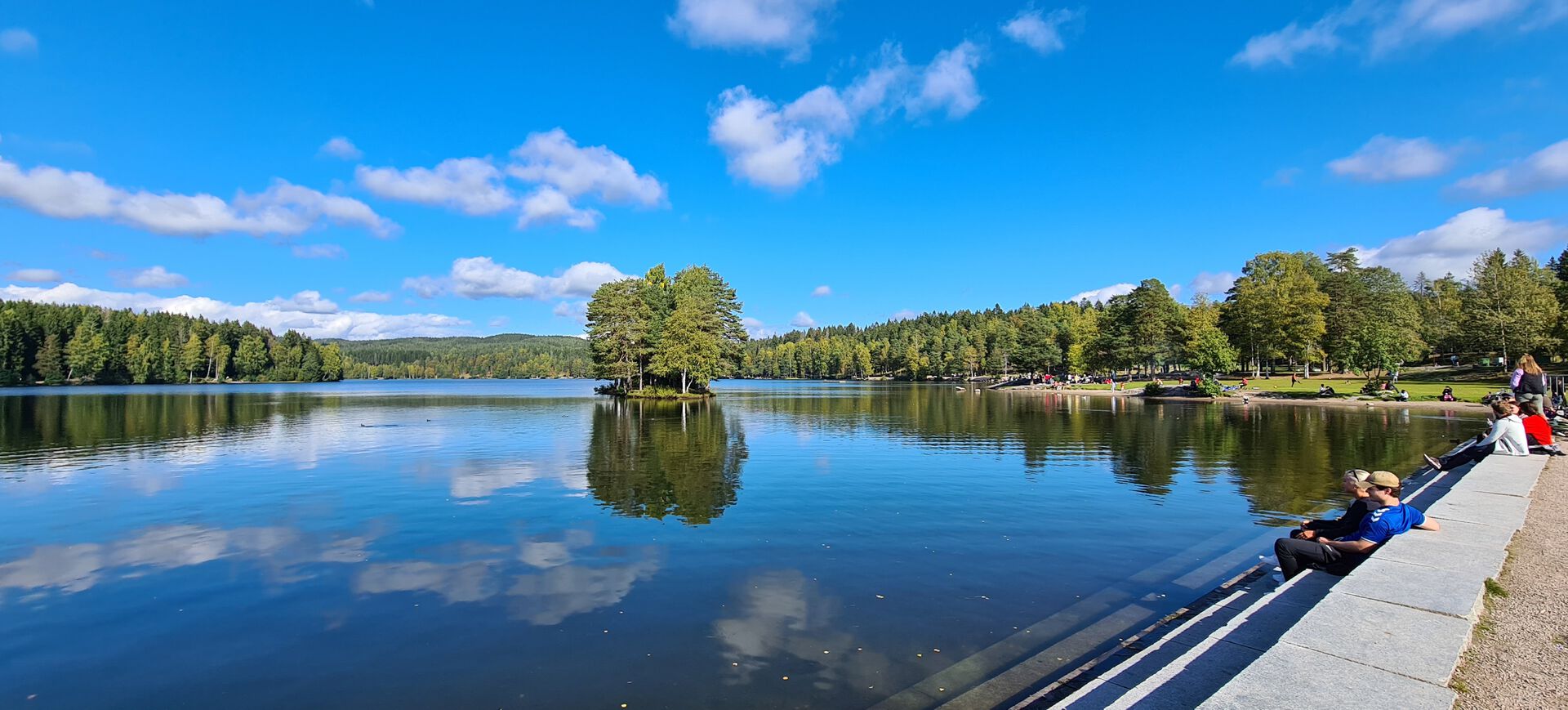
The Norwegian School of Sport Sciences is located in the Northern part of Oslo, next by the Sognsvann lake and Nordmarka. Nordmarka is a big forest region with ample outdoor recreation opportunities all year round.
Accommodation
The conference venue is located 15 minutes with the Metro from the city center. Most hotels in Oslo are located in the city center, which makes it more convenient for individuals to stay there. This is because the Metro known as the T-bane, provides easy transportation to the conference venue.
If you prefer to stay in closer to the conference venue, there are two notable options. The Scandic Olympiatoppen Sports hotel is located 100 meters from the conference venue. The hotel is a part of the Olympic Sport Centre that has been given the operational responsibility and authority to develop Norwegian top-level sports athletes. Thon Hotel Ullevaal is strategically located between the city center and the conference venue, at the Norwegian National Football Arena, with the added advantage of being along the metro line.
Public Transit
Take Metro line 5 towards Sognsvann. The conference venue is across the street from the end stop. Find departure times and plan your journey at ruter.no/en/
From Oslo airport you can use the airport train or the regular train to Oslo Central Station. The regular train is a cheaper alternative. The Metro station is in the same building, two floors down.

Driving directions
Take Ring 3, to the exit for Ullevål Stadion, and follow the signs to Sognsvann. You can park at NIH for a fee or park nearby at Sognsvann for free.
Location
See our location in Google Maps
About CRIC
The Cluster for Research into Coaching (CRiC) was formed at Manchester Metropolitan University in 2010 under the leadership of Professor Dave Day and Dr Bill Taylor with aim of developing critical coaching scholarship in the fields of pedagogy, sociology, history and law. CRiC has become known as the leading research group in the UK concerned with the sociology, pedagogy, history and ethics of sports coaching. CRiC has an emerging international reputation in these areas and will seek to continue to grow in influence and reputation.
Contact

- christiab@nih.no
- Phone
- +47 23 26 24 68

- lenero@nih.no
- Phone
- +47 23 26 24 35
Call for Abstracts
We wish to support established scholars (>4 years post PhD), early career researchers (ECR <5 years post PhD), doctoral and postgraduate (PG) students.
Instructions
We call for abstracts from:
- ECR, PhD or PG researchers for presentations (10 minutes) (N.B. 15 slots available).
- Established scholars (>4 years post PhD) (N.B. 15 slots available).
Submissions should follow the guidelines below:
- By submission of an abstract you are agreeing to present if, and as, scheduled within the conference programme.
- The presenting author for the abstract submitted should be the first author of the submission.
- Individuals should only be the first author (i.e., presenting author) on one abstract i.e. one presentation per person.
- Abstracts should include a title, names and affiliations of all authors, and introduce the substance of your presentation (e.g., background, aim, methods, results, and conclusion).
- Abstracts are restricted to 500 words (not including title, authors, or affiliations).
- Abstracts should be in keeping with the CRiC aspirations to critically understand sports coaching and its complexity through theoretically informed analyses.
- Abstracts may or may not include published work, but should not include proposals for studies.
Abstract submission
The deadline for abstract submission is January 31th 2025. To upload you abstract use the link to Nettskjema (self-service online form) or QR-code.