
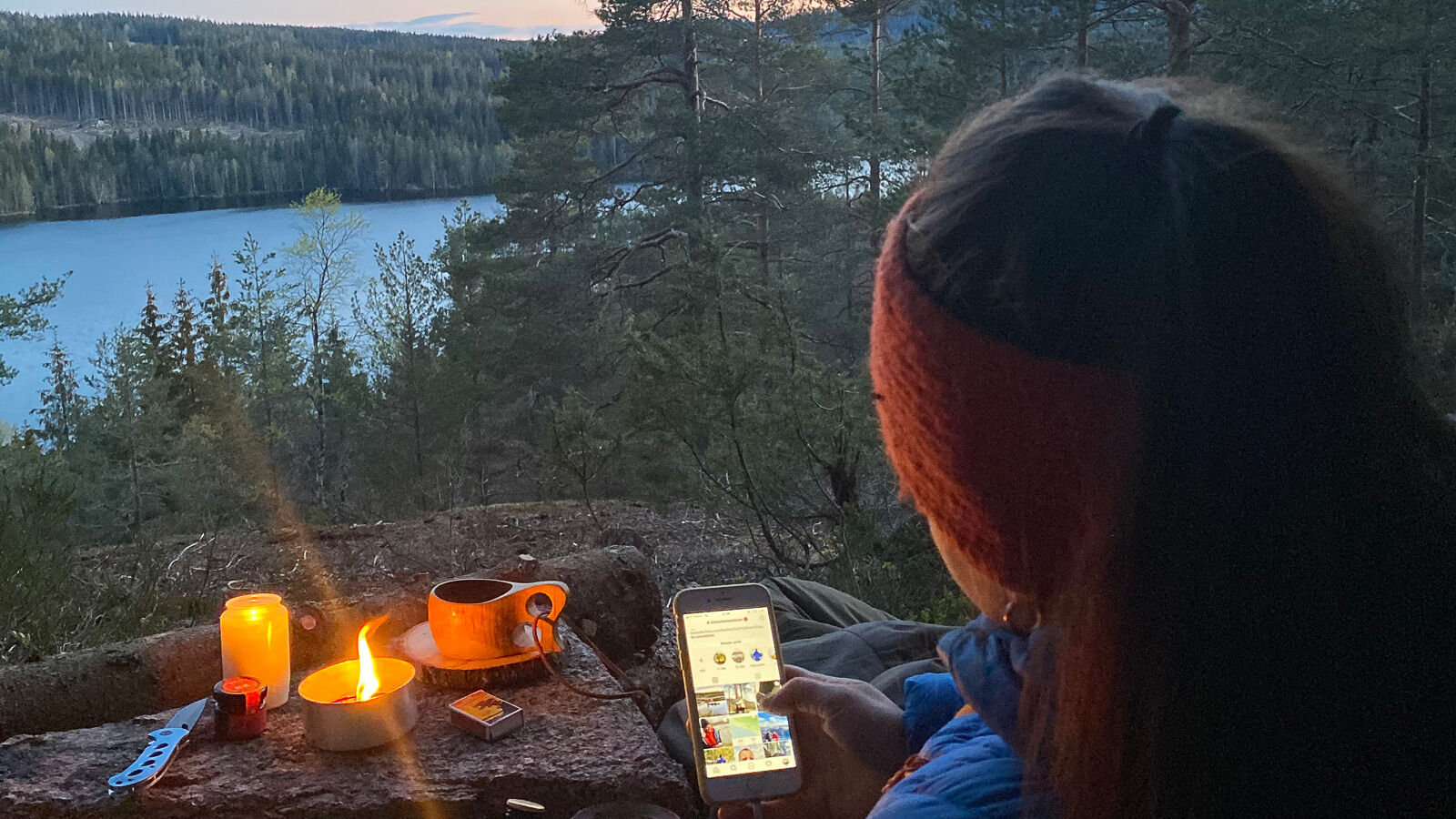
When it comes to outdoor activities such as hiking or cross-country skiing, the biggest cultural shift in the last quarter century has been that most people will have a mobile telephone with them. This, in itself, is not surprising. Indeed, 99% percent of 16- to 44-year-olds in Norway use one1, and it is probably safe to assume that most Norwegians take their phones with them while on day and multi-day trips.
The research conducted on mobile phone use in outdoor education, outdoor leisure and nature tourism is catching up to the meteoric rise in mobile phone use (and, by extension, social media use). When summarized, the literature on the outdoors, mobile phone and social media use, shows that there are two inescapable truths, limitless pros and cons, and one very big implication for practice. While this discussion relates to more formally organized outdoor experiences, the findings will be useful to families and groups of friends who venture outdoors together.
Pros and cons of smartphones in nature
The first truth is that having a mobile phone while outdoors alters our interactions with the landscapes we are travelling through. The second is that it alters our interactions with the people we are with2. The word ‘alter’ is chosen carefully, as it is fairly neutral.
Mobile phones have many wonderful affordances, such as being a portable reference source for flower identification, navigating, and seeing the latest weather forecast. Their inbuilt cameras allow us to snap photos and share experiences with non-present others. The flip side of is that these devices can rob us of the capacity to foster deeper connections with the places we visit and with our group mates who are travelling with us.
Many of these positives and negatives have been highlighted in recent PhD research conducted at the Norwegian School of Sport Sciences by Imre van Kraalingen3 and Axel Rosenberg4, in their respective studies in the fields of outdoor education and nature tourism. Further PhD research by Jack Reed in the UK has shown that in residential outdoor education programs, neither allowing participants to use their phones whenever they like or nor banning phone use during activities is helpful5. The former can disrupt pedagogical processes and derail educational aims, while the latter can be very stressful for younger teenagers, in particular.
All three researchers had data that pointed to the stress attached to creating images and stories about what they were doing which could be shared with ‘non present others’. At one end of this spectrum, one can have individuals who are overly focused on being celebrities in our own travel documentaries6, while at the other end are teenagers just wanting to have a morning and nightly check-in with their parents.
Have “the talk” before you set out
Despite working in three very different contexts, all three researchers arrived at a similar recommendation for all those facilitating outdoor experiences for others. They highlight the importance of trip leaders having discussions with their groups about appropriate use of mobile phones while on program. This might involve only using phones while being out of sight and hearing distance from one’s group members, or having designated periods in the day when people can pull out their phones to check messages or post a photo on social media.
What is crucial is that these discussions are had well in advance of the trip so that people have plenty of time to make arrangements with friends, family, and their social media ‘publics’, that will enable them to navigate through the limited opportunities to communicate. Expectation management around mobile phone use is of central importance.
It's not for me tell you if you should be bringing your phone with you on your hiking trip or not, or how you should be using it, if you do. What I will say is that if you are leading a trip for others or going on a trip with friends and family, do take some time before you leave to discuss and agree upon certain ‘phone rules’ that you can adopt for your time away together. This will help to ensure you connect with nature and with each other in the best ways possible.
References
- Statistisk sentralbyrå. (2023). Norsk mediebarometer (pdf).
- Beames, S. (2017). Innovation and outdoor education. Journal of Outdoor and Environmental Education, 20(1), 2-6.
- Van Kraalingen, I., & Beames, S. (2024). Presence and (dis) connectedness–the influence of smartphones usage on human–nature and human–human interactions in outdoor studies. Frontiers in Education, 9.
- Rosenberg, A. (2024). Reflections on the impact of the digital shift in nature-based adventure tourism: Connected disconnections in the arctic. In S.K. Beames & P.T. Maher, Routledge handbook of mobile technology, social media and the outdoors (pp. 321-329). Routledge.
- Reed, J., Beames, S.K., MacLeod, G. (2025). Young people's networked constructions of nature: Evidence from a qualitative multiple case study in England, Scotland, and Wales. People and Nature.
- Beames, S.K. (2025). Changes in nature tourism: Networked architectures and the celebrification of the self. In B. Henderson (Ed), Purposeful travel as told through two Himalayan stories 1971-2023. Your Nickel’s Worth Publishing.